This archive is being rewritten. Its lore text was first drafted with AI. It is now being rewritten by hand and checked against the sources, in line with community lore guidelines.
Please do not cite it. Until that work is finished, do not share anything here as confirmation or evidence of the lore. Go to the sources listed under References.
The theories are theories. They are fan speculation, not canon.
You will not be asked again on this device.
ACD TERMINALR1999-Σ
□▣
ACD · Anomalous Chronology DivisionRecord of the StormReverse: 1999
ITEM R1999‑Σ · CLASS: ANOMALOUSReading mode
ACD — Record of the Storm
The truth lies in the record, as well as in the Storm.
ST. PAVLOV FOUNDATION · ARCHIVE ROOM
Opening Note
Compiled by a mad observer who believes he belongs among Laplace's researchers, or at least yearns to — in the hope it helps somebody make sense of the Storm.
Best on a laptop. A phone can survive this archive. For the sprawling charts, give this mad observer a larger screen. Your thumbs deserve a break.
What this is
A fan-made log of every confirmed Storm — when it fired, what it overwrote, where it sits in the story.
How to use it
Pick a Storm on the timeline and read its record beside it. New to the game? Primer of the Storm, first in the menu, is the short version.
Disclaimer & spoilers. Unofficial fan project, not affiliated with or endorsed by Bluepoch. Covers Chapters 1–13, with spoilers throughout.
The Record
Eleven Storms on one timeline. Pick a numbered bracket and its record opens beside it; the two are meant to be read together.
Records examined 0/11
Drag the timeline to pan, zoom with the buttons or “Full”. “Clear” drops the selection.
Tap a row to open its record below. The circle marks departure; the arrow marks arrival.
Overwrite Register— calendar year (CE), a line compares values, it isn't a path
regress advance
100%
Every numbered bracket is one Storm: the year the world was in, and the year it was thrown to. The line joining them compares two years. Nothing travelled along it.
MAIN OBSERVATION
Detail Record
Shows the Storm you last picked. With nothing picked, a summary of all eleven.
Overwrite Register — Full Timeline
Supporting indices · chronology, recurrence and interval
Chronological Register
Original year, real time — always moves forward.
The eleven Storms in the order they happened, in real time. This is the order of events, not the order of the years they landed in.
Recurrence by Decade
How often each decade gets picked as a target — not that anyone visited twice.
Exercise How many times each decade was the landing point. Landing in the 1920s twice does not mean the same 1920s came back.
Interval Between Storms
Elapsed time before the next Storm. Log-scale bars; date bounds are shown as whiskers.
How long the world stayed in one era before the next Storm. Bars with whiskers are estimates; the sources give a range, not a date.
Some record-keepers get a little consumed by it. We don't judge.
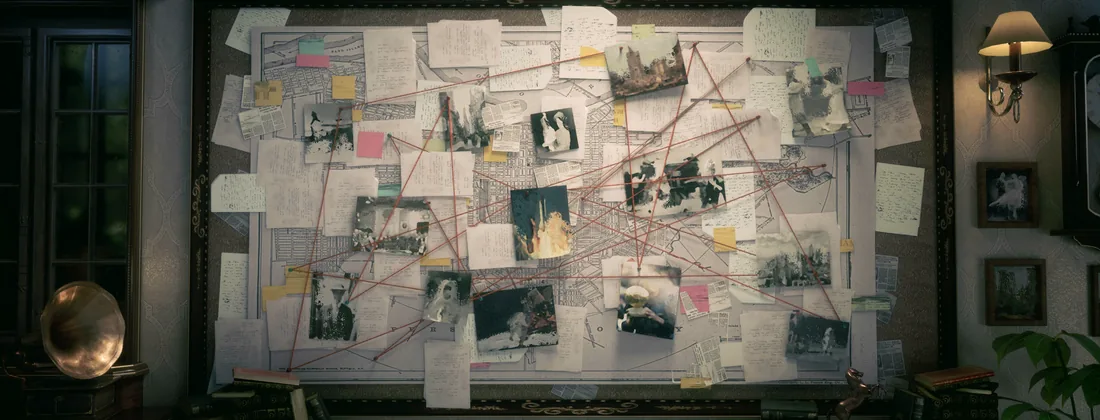
the suitcaseThe wall version of the table below: photographs, and string between the ones that turned out to be the same story.
Storm Fundamentals
Not time travel. Nothing "travels" through the years between — 1966 doesn't pass through 1965, 1964... it just stops being 1966.
ORIGINAL
The real year. Moves forward normally, always.
ERA
The era a struck region gets overwritten to. Jumps — no order, no warning.
Confirmed boundary: never crosses 1900 or 1999.
Terminology — the words this page leans on hardest. Pick one.
Term
What it means on this page
ACD
The Anomalous Chronology Division — the department this archive writes as. It is our own invention, not part of the game: a division that co-exists with Laplace and collaborates with it on Storm research.
Arcanum / Arcanist
The magic and the people who use it. Arcanists generally survive an overwrite better than ordinary humans, but not automatically.
Artificial Storm
One that didn't happen on its own. Four confirmed: #5 (Laurent Roseau, a Manus Vindictae affiliate, tore the rift in A Flowing Feast — the first deliberately-triggered case), then #8 and #9 by Manus Vindictae, and #10, tested on purpose by the Foundation itself.
Asymmetrical Nuclide R
The nuclide the Storm itself carries — present in its rainwater and in the "cores" that make a location an Immunity Zone. What the Equilibrium Umbrella actually extracts from the air during a Storm.
Emanation
Apeiron's own word for the Storm, not the general one — meaning "to come forth [from the source]": their belief is that it releases a person's essence and destroys the physical body. This archive says "Storm" throughout, as the game does, and numbers each occurrence Storm 1 to Storm 11.
Equilibrium Umbrella
The portable "Storm" immunity device Laplace built during Vereinsamt — pairs Asymmetrical Nuclide R extraction with the Hofmann Knot so whoever carries it is protected.
Foundation
The St. Pavlov Foundation — studies the Storm, shelters people from it, has never once solved it.
Hofmann Knot
A literal knot, tied as a medium so anyone — Arcanist or not — can invoke the immunity ritual La Unua Cirklo without being able to read its incantation. Built by Laplace, Team Timekeeper, and Apeiron after the ritual itself proved unreadable and fatal to cast directly; survival odds around 0.49%.
IDM Computer
37's device for logging Original/Era pairs as they happen — the in-game source this whole page's framework is built on.
Immunity Zone
Anywhere built or blessed to skip an overwrite entirely — the Foundation HQ, Vertin's suitcase, 37's island. None are perfect or permanent.
La Unua Cirklo
Esperanto for "The First Circle" — the actual incantation of the Storm-immunity ritual. Apeiron's ancestors cast a variant of it to protect their island; Vertin can read it because her mother taught her the language.
Laplace
Short for the Laplace Scientific Computing Center — the in-game institute that studies the Storm. The ACD works alongside it, which is why this terminal looks like one of theirs.
Manus Vindictae
The faction trying to force the world backward "in the right order" — and the group behind three of the four confirmed artificial Storms.
Original
The real calendar year, ticking forward normally. Never resets, never skips.
Overwrite
What actually happens, instead of travel: a place's Era value gets replaced, all at once, no transition.
Era
The year a struck region gets forced to display instead — called "Phenomenal" in-game. Has no relationship to Original beyond "it changed."
Regression / Advance
Whether a Storm's Era value moved earlier (regression) or later (advance) than what came before it.
Regulus Record
The immunity medium built from Regulus-satellite materials, tested in side story 2.4 and used for real in Chapter 10 — see Time Travel Rules, below.
Reversed
What happens to a person or object caught in the overwrite — rebuilt as whoever they'd be in the new era, not restored as their old self.
Storm Syndrome
An illness in the population, not an effect of the Storm. It takes hold during an era and runs until the Storm ends that era — so each syndrome is filed here against the Storm it leads up to, never the one that created the era. Its defining feature is that sufferers do not know they are ill: the official account of the 1929 outbreak notes the patients were unaware of their disease “not even when the ‘Storm’ reversed the era.” Every recorded syndrome takes a different form — wiring in place of blood, food seen as gold, bodies turning to paint, an era folding in on itself. Earlier records also describe mass hallucination and panic in the last day or so before impact. This is a separate field from what the Storm did, which is the damage done at the moment it fires.
Temporal Anomaly
The St. Pavlov Foundation's own umbrella term for this class of phenomena before the word “Storm” was settled on — covering time reversal, the disappearance of buildings, the erasure of populations and historical discontinuities, all filed separately for years. The Nowa Miedź Project established they were one systemic disaster. The Storm Act (Temporary) retains “Temporal Anomaly” solely as a legacy term from the earlier records.
Points Irreversible
The collective name for sites where a Temporal Anomaly has occurred but it is not established whether it always results in time reversal. Lucy's framing: the label stands in until there is a more comprehensive understanding of the sites in question.
Storm Act (Temporary)
The Foundation's provisional legislation. It fixes “Storm” as a highly dangerous disaster whose core manifestations are time reversal, historical erosion and the reconstruction of reality, and assigns the Foundation research, early warning, takeover of endangered zones, evacuation, preservation of civilisation and the humanitarian restoration of survivors' identities. Who bears primary responsibility is still under dispute. Current research priority: early-warning mechanisms, a better emergency response system, and the possibility of crossing or ending the Storm altogether.
Timekeeper
Vertin's title. The only person confirmed to stay herself, memories intact, across every single Storm.
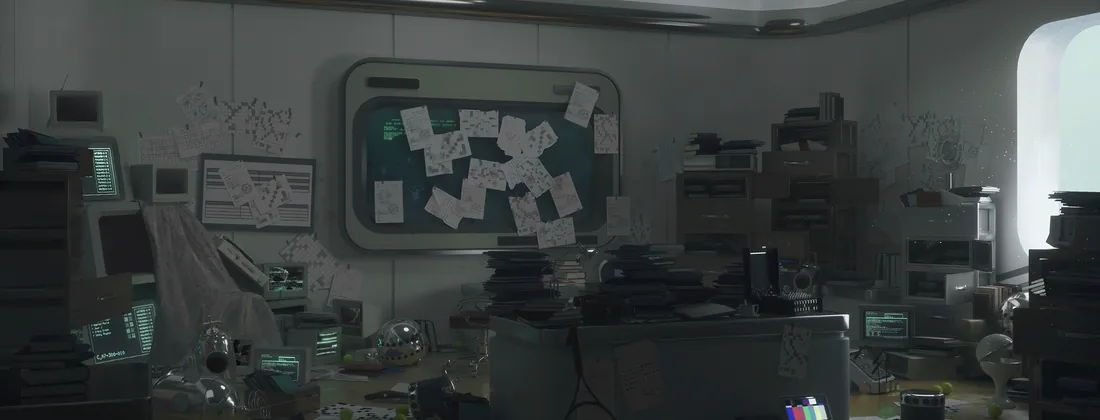
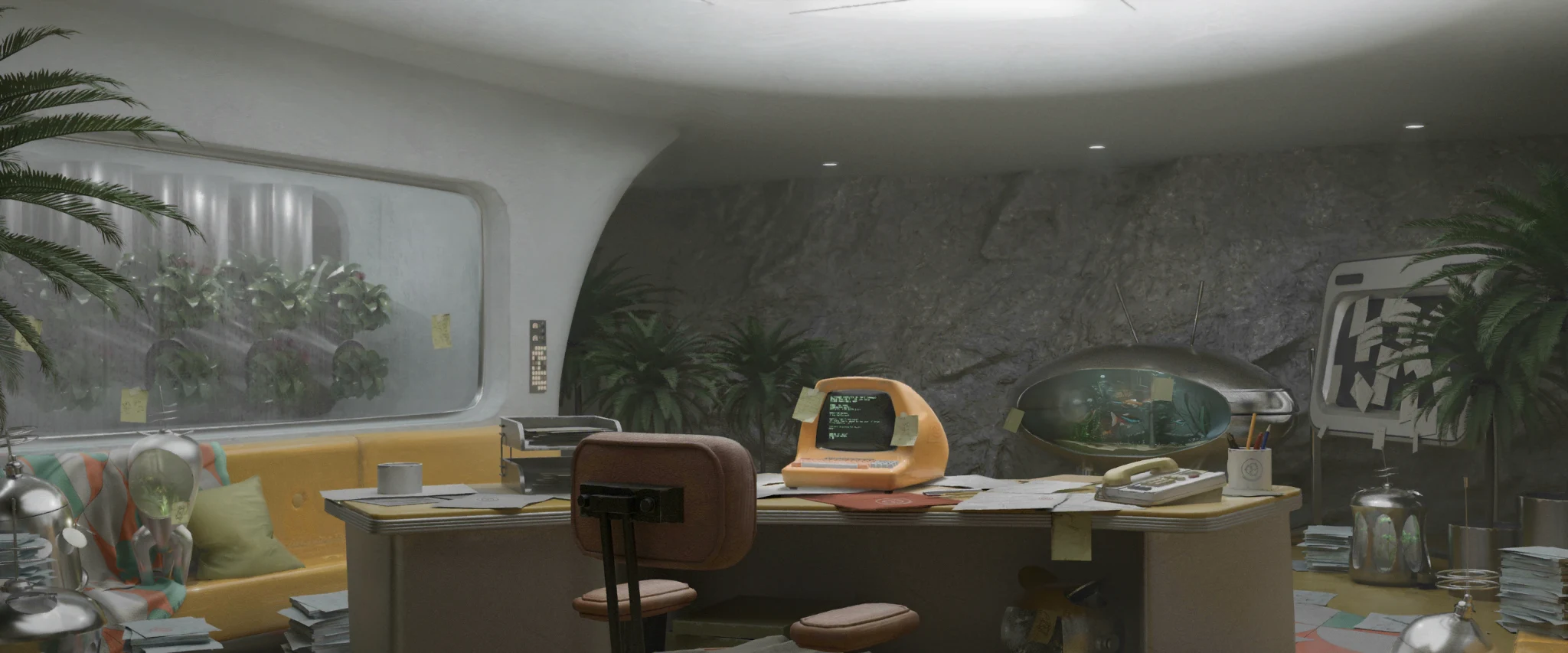
Laplace, an officeSomebody’s desk mid-argument with the evidence. Most of what follows was worked out in rooms like this one.
Getting to Know the Storm Together
Seven questions people ask about the Storm, and what the record answers. Pick a question.
Field record: even mid-Storm, physics holds — "it does not go against the laws of physics."
Arcanists aren't automatically safe — need to resist mass hysteria (Storm Syndrome) or have ritual protection, or they get reversed too.
The Foundation tested the Grandfather Paradox directly: poisoned a tatzelwurm in 1929 with venom collected from the same creature in 1930. Result — just a dead worm, no paradox.
Per Medicine Pocket and Regulus (1st-anniversary "Storm Science" segment): no record of anyone meeting their own past self, not even after small jumps — not confirmed impossible, just never observed.
People reversed by the Storm aren't restored as who they were — they're recreated as who they'd be in the new era, different identity and life. Vertin is the one confirmed exception who stays herself across every jump.
The first confirmed deliberate trigger: side story A Flowing Feast, where Manus Vindictae affiliate Laurent Roseau tears open a rift between the Depths of Myth and the material world in Paris, forcing the 5th Storm as the Storm reacts to the breach.
An immunity version has been deliberately built too: side story 2.4, Last Evenings on Earth, where Ulrich tests candidate materials from the Regulus satellite — works properly in Chapter 10 as the Regulus Record.
Reincarnators are a separate phenomenon entirely — a soul persisting death and surfacing in a new body (Spathodea, and suspected of Dorothy of London). It isn't the same mechanism as Urd's case, which is cross-Storm persistence in one continuous life, not rebirth.
Notable Cases pick a file
Urd (as Dr. Dores)
Confirmed
One soul, reincarnating every single Storm with no exceptions. In the 10th, she's living as Dr. Dores — overwritten while stopping the spinning wheel by hand, dying doing it, and reincarnating again afterward as Urd, eventually recovering those memories too.
Voyager 1
Confirmed
2.7, 1987: Cosmic Overture sends a Laplace team into deep space specifically because Voyager 1 was found untouched by the Storm — preserved, not reversed. Suggests the Storm's reach may not extend that far into space, though the "why" is still unexplained.
Spathodea
Theory, unconfirmed
Debuts in the 1990s with no earlier trace in the record. Confirmed as a Reincarnator — a distinct Arcanum origin (a soul reborn into a new body, seen elsewhere in Dorothy of London's suspected past-life memories), not the same phenomenon as Urd's cross-Storm persistence. Whether that history connects to the Storm at all remains an open question, flagged here rather than answered.
◆
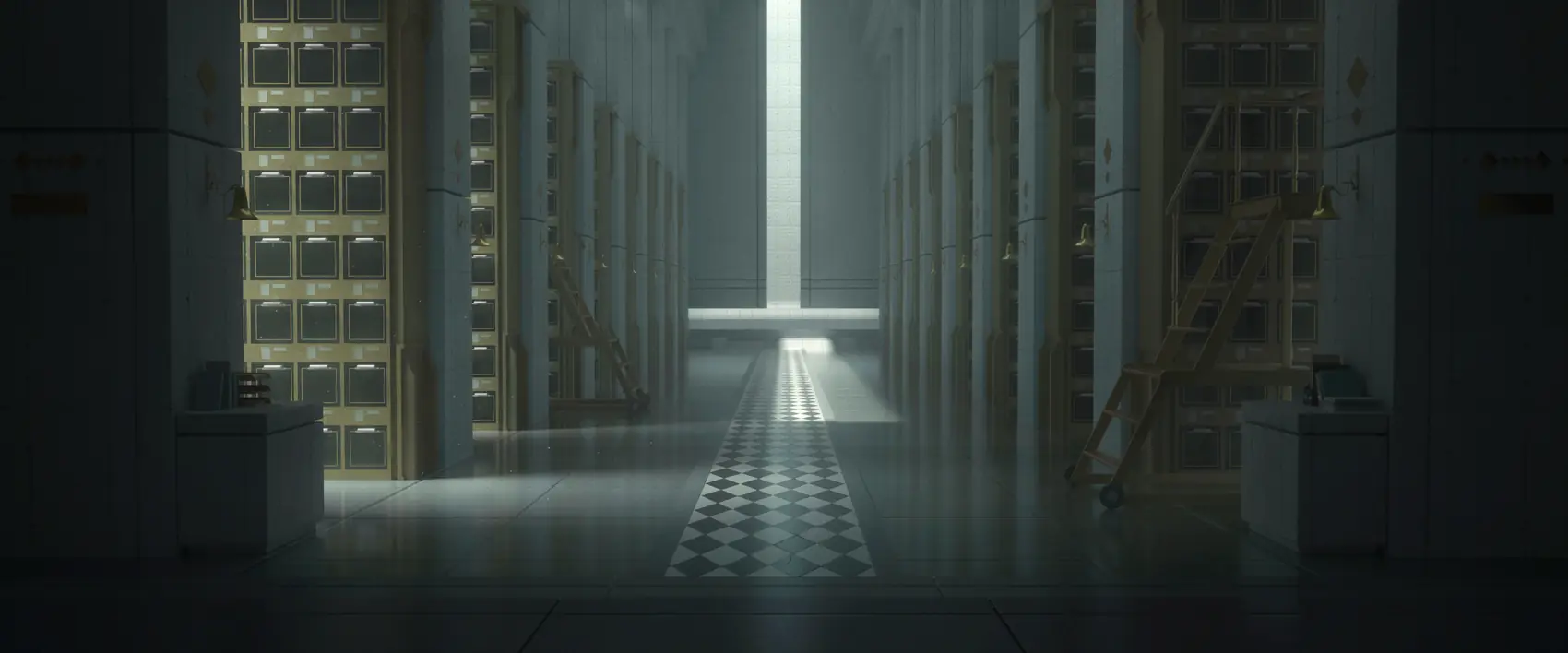
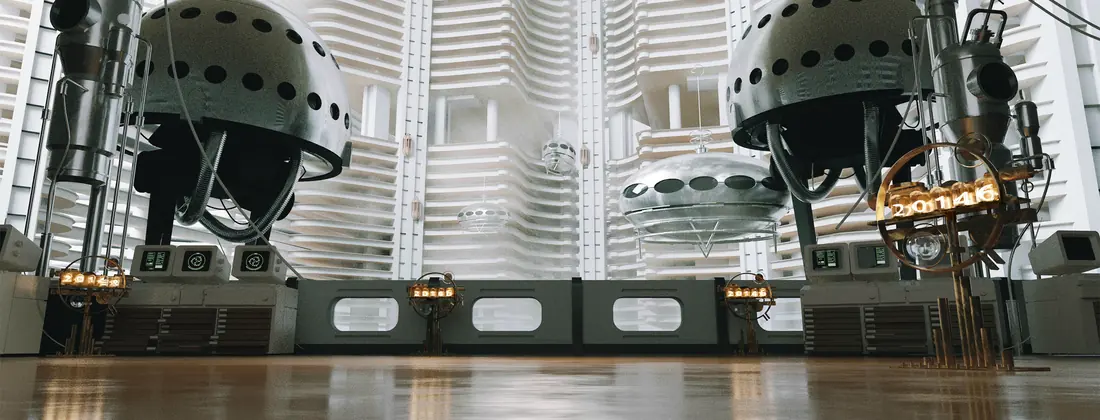
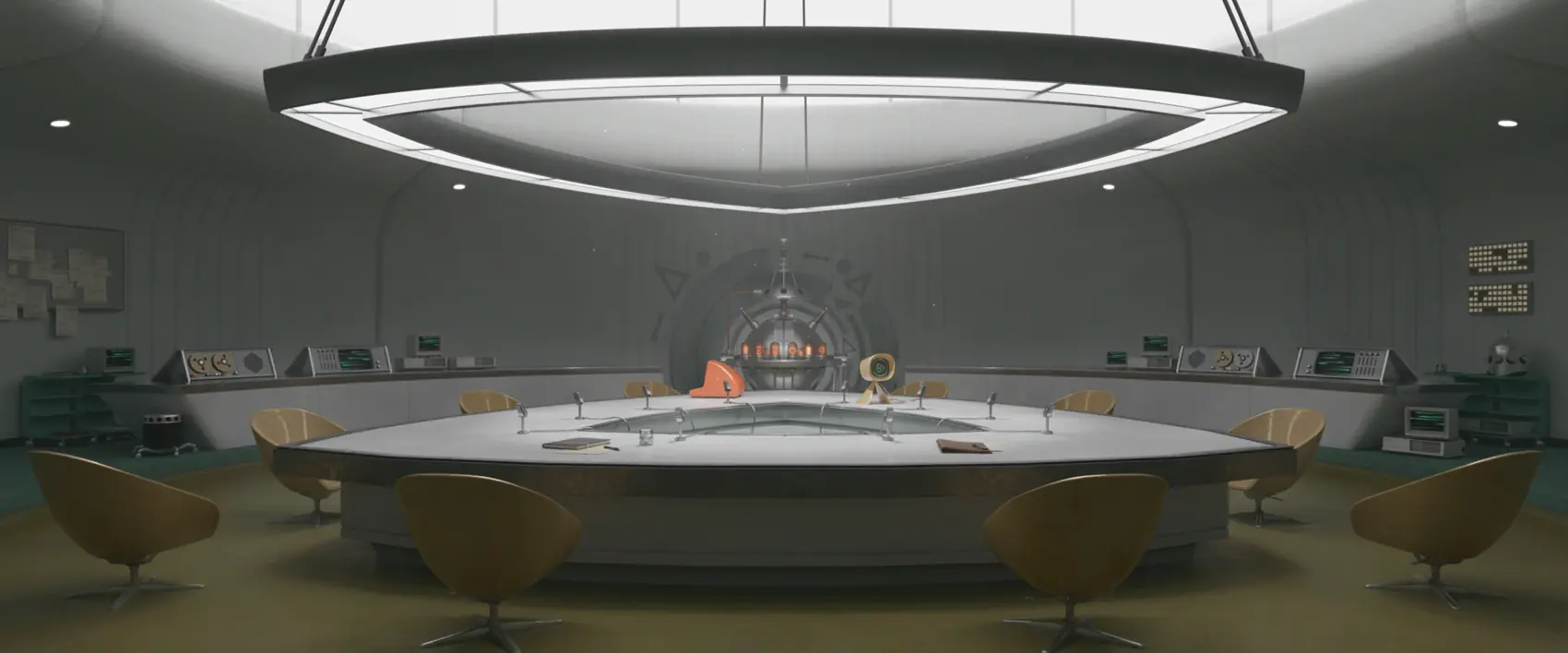
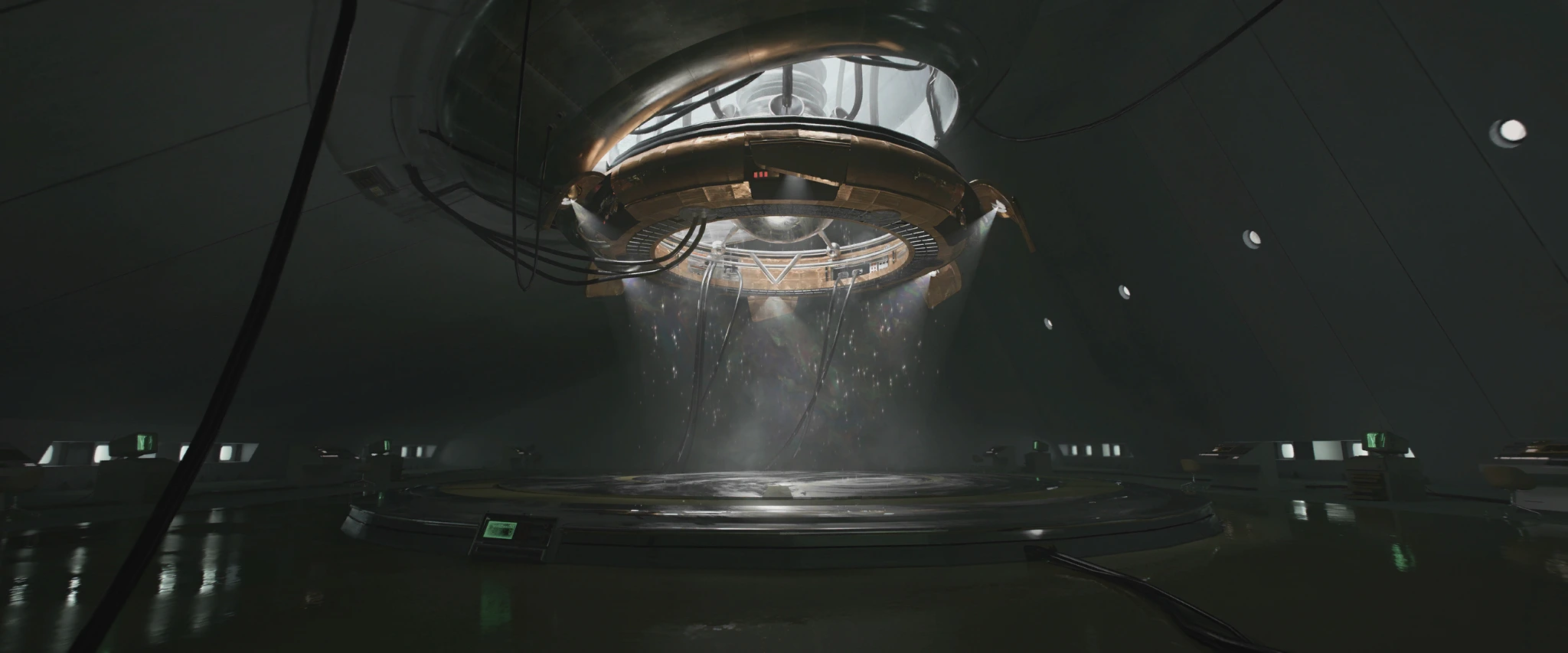
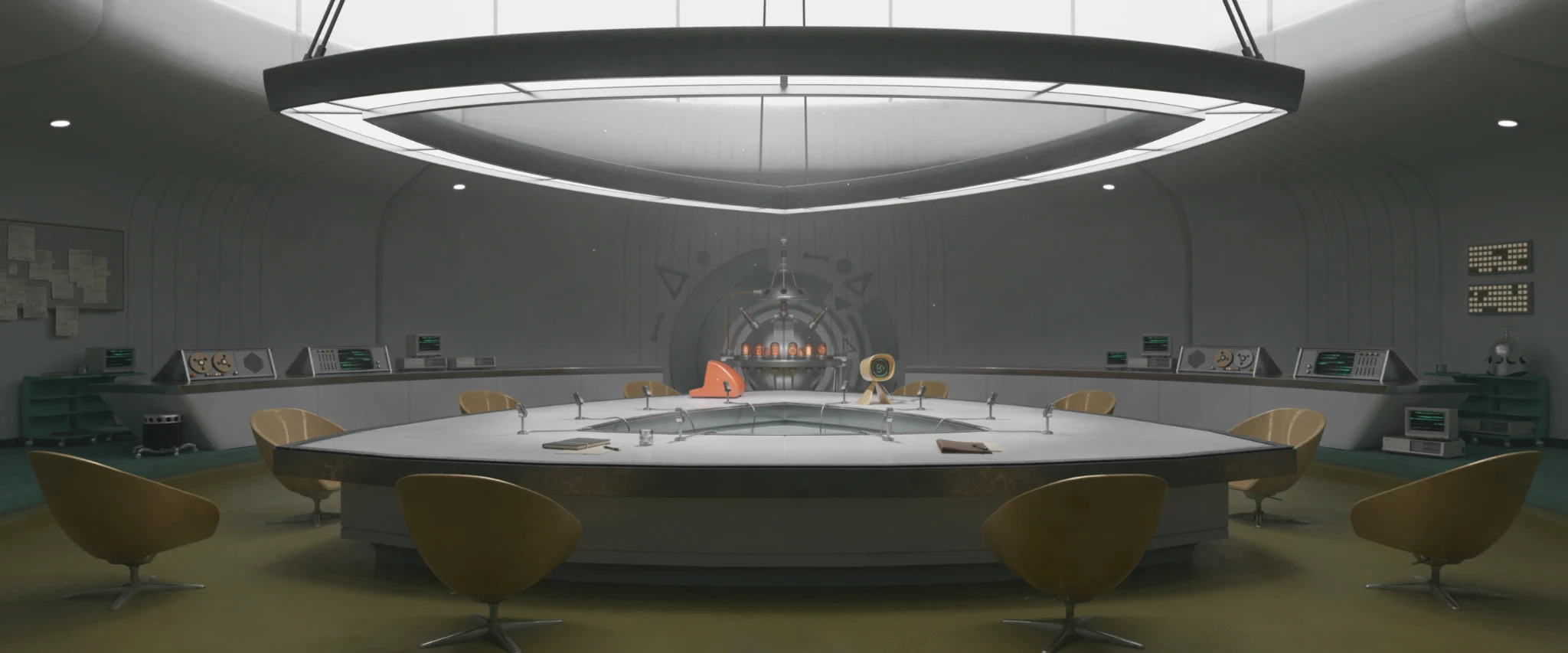
Laplace, main hallThe instruments that do the looking. Whatever the Storm is, this is the end of the apparatus pointed at it.
trigger siteengagement sitedrag to spin
DOCUMENTED SPACE
Geographic Register
Places the story names in connection with a Storm. Select a marker or a row to fly there and open its Storm record. A marker shows where something happened, not how far the Storm reached.
7 locations across 4 Storms · 7 Storms unlocated · a trigger site and an engagement site are different kinds of evidence
◆
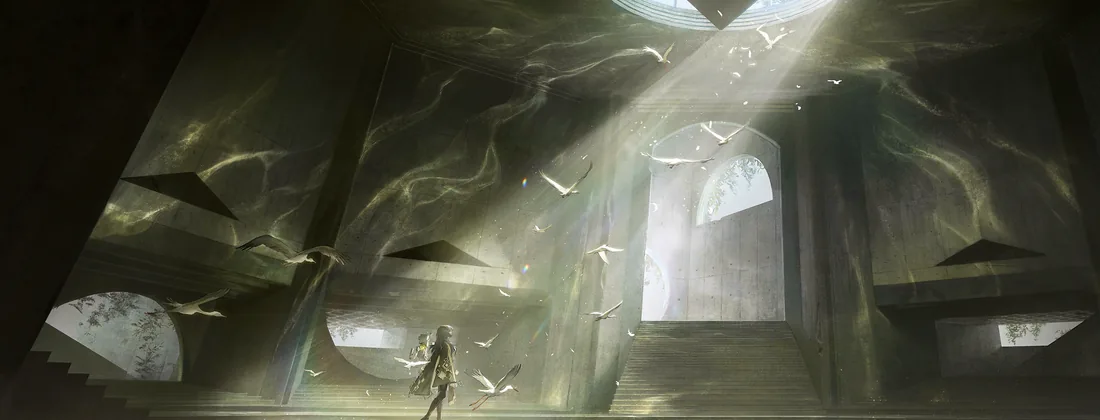
site unrecordedGeometry that should not hold itself up, holding itself up anyway. The record keeps the photograph and declines to explain it.
Chapter Placement
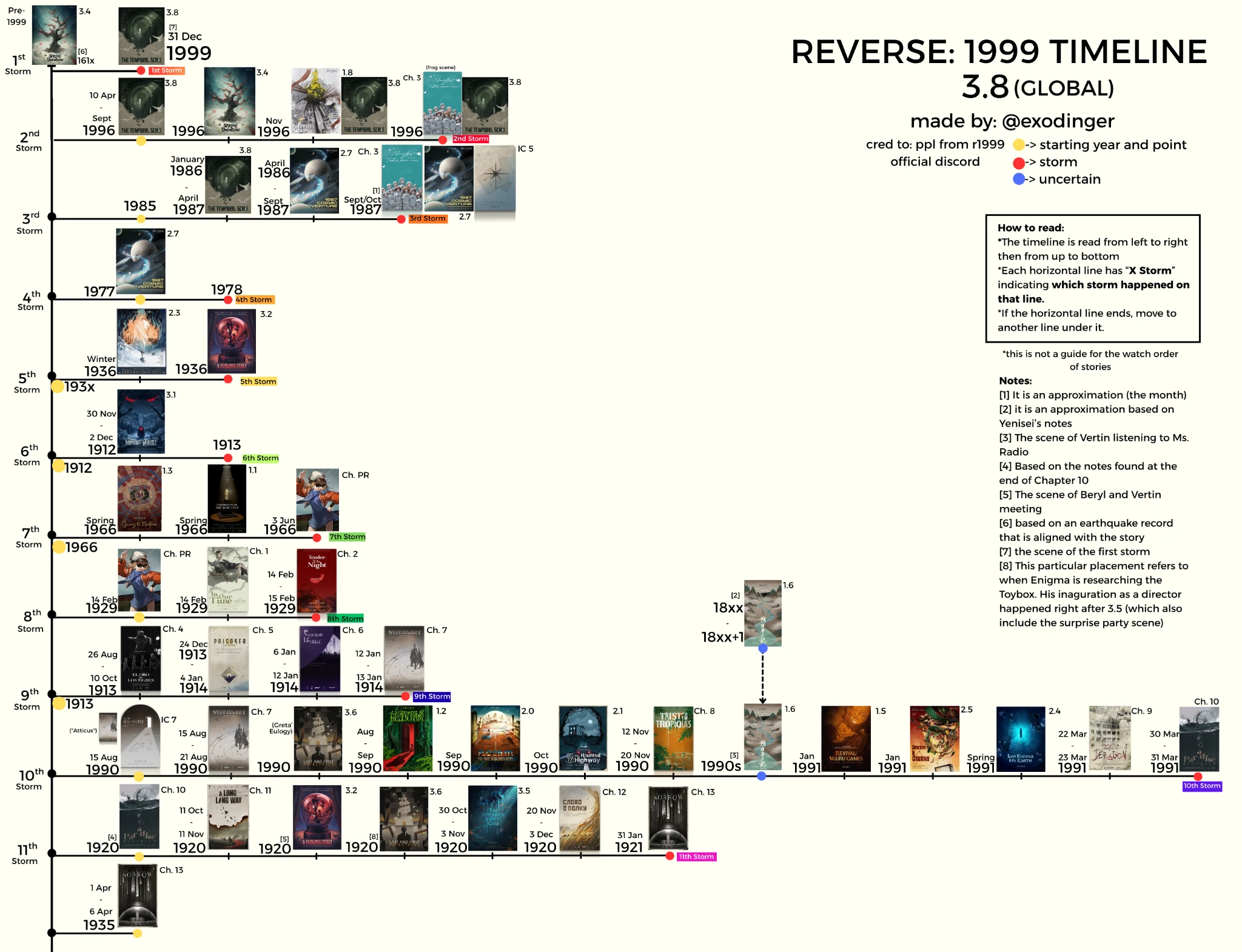
Every chapter and side story on record, laid along the era it happens in. Dates are
@exodinger's research, from the community chart "REVERSE: 1999 TIMELINE 3.8 (GLOBAL)",
credited by its author to contributors from the r/Reverse1999 official Discord. The chart itself is
their work and worth seeking out — this is our own layout of the same dates, drawn in this
page's instrument style rather than reproducing theirs. Select any era to open the Storms that
bracket it.
Where each story chapter sits among the eras. The order you play the chapters is not the order of the years.
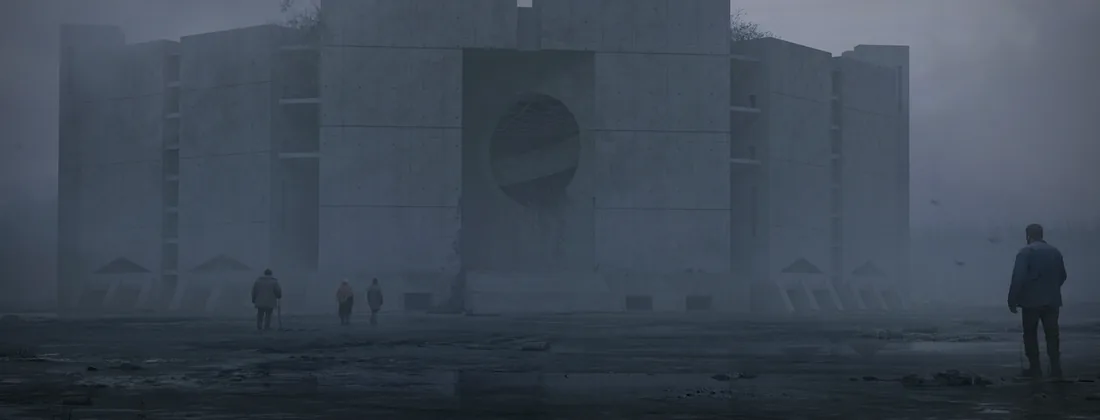
a point irreversiblePhotographed from the outside. Nobody has established whether the anomaly here always runs time backwards — which is precisely why it carries that name.
The same stories as a table: chapters by era
Which chapters and side stories are set in each era, and which Storm opened or closed it. Select a row to open that era's bounding Storms. The same century can appear in more than one stretch, because eras follow the order of the Storms.
IDM Computer Log: Original and Era, per the in-game readout
Select a row to open its record above.
Foundation archiveWhere a record like this is supposed to end up. Everything on this page came out of somebody else’s reading first — the names are below.
SEVEN WAYS OF LOOKING AT ELEVEN STORMS
An Anatomy Of The Reversal
Read these as exercises. Eleven events are enough to describe what happened and far too few to prove a pattern. Pick a view; a numbered mark opens that Storm’s Detail Record.
1 OF 7 · SIGNED DISPLACEMENT · Δᵢ
How far each Storm moved the calendar
Destination year minus departure year. Left of zero is backward, right is forward.
What it shows. What happened, not why. Early dates are approximate.
Method, data & sources
Δᵢ = destinationᵢ − departureᵢ. Rounded calendar-year labels, not exact fractional years. Source: this archive's register, checked against @exodinger's 3.8 community timeline, which puts the sixth departure in 1913. Event order is preserved.
2 OF 7 · CUMULATIVE ERA DRIFT · Cₙ Exercise
A running total of every jump
Each row adds that Storm’s jump to the total before it. Ordinary years lived between Storms are left out.
What it shows. The record drifts backward overall, in a few large steps, not a steady slide.
Method, data & sources
C₀ = 0; Cₙ = Cₙ₋₁ + Δₙ. This is a descriptive cumulative sum, not a calibrated statistical change-detection test. Drift here refers to jump displacement and excludes ordinary passage.
● Solid recorded landing year○ Dashed · jumps only, from 1999
3 OF 7 · CALENDAR ACCOUNTING
Jumps, plus the years lived in between
The landing year holds two things: what the Storms overwrote, and the ordinary time people lived between them. The gap between the two lines is that ordinary time.
Accounting identity & data
Landingₙ = 1999 + ΣΔᵢ + Σ(departureᵢ − destinationᵢ₋₁). The first pre-Storm baseline is 1999. Calendar-year arithmetic rounds partial years; it is not the IDM's Original clock. Lines connect event order, not evenly spaced elapsed time.
4 OF 7 · TRANSITION MATRIX · Nᵢⱼ Exercise
From which decade, to which decade
Read a row as “left from this decade” and a column as “arrived in this decade”. A bright cell means it happened. Click one to open its record.
What it shows. History, not odds. An empty cell means it has not happened in eleven tries, not that it cannot.
Transition counts & limitations
Decades are floor(year / 10) × 10. Each Storm contributes exactly one observation. Eleven observations cannot establish stable transition probabilities. This matrix is not a Markov forecast.
5 OF 7 · INTER-STORM DURATION · τᵢ
How long each era lasted
From a landing to the next departure, drawn from shortest plausible to longest. The scale is stretched so that days and years fit on one chart.
What it shows. Eras run from a single day to about three years. Circles are midpoints for positioning, not measured dates.
Date bounds & evidence
Lines show documented or reconstructed date bounds on a log₁₀(days + 1) scale. Later windows use dates from the 3.8 community timeline. Earlier ranges use coarse year labels, not confidence intervals. 5 → 6 assumes a landing between 30 Nov and 2 Dec 1912 and a departure somewhere in 1913 (30–396 days). Same-date events are shown as 0 rounded days. The ongoing eleventh era is excluded.
6 OF 7 · INTERVENTION & DIRECTION
What the story credits with setting each one off
Storms the story attributes to someone’s intervention, against Storms with no stated trigger, grouped by direction.
What it shows. A count of mentions, not proof of a cause. “Unknown” does not mean natural.
Classification ledger & sources
Storms 1, 5, 8, 9 and 10 have intervention accounts in the existing register or community lore summary. This is a manually reviewed evidence ledger; it does not infer that intervention determines jump size or direction.
7 OF 7 · WARNING-WINDOW BUDGET Exercise
Twenty-four hours before a Storm
Chapter 7TH-03 describes a 24-hour warning. Spend it: move the three sliders and see what is left.
What it shows. Buffer = 24 − delay − fieldwork − evacuation. The deadline is from the story; the numbers are yours. It models neither spread nor shelter reliability.
ParisParis, with a second Paris hanging above it. Whichever way up you read the city, the era underneath it has already moved.
Open Cases
What this record cannot answer yet. If you know a source, or think an entry is wrong, file it below and it reaches the compiler directly.
CASE A
Seven Storms have no documented origin site. Storms 1, 2, 3, 4, 6, 9 and 11 are missing from the Geographic Register.
CASE B
Several triggers are simply “not stated”. Is there a line of dialogue, an event story or an item description that says more?
CASE C
The record never leaves 1900–1999. The boundary is confirmed; the reason for it is not.
Nhong was here
References
Where this page's information actually comes from, in case you want to go check it yourself.
Unofficial Reverse: 1999 Lore FAQ & Directory — managed by Deimos (@deimoshardware) and Rabies (@jackyvile), in collaboration with members of #r99-global-story-spoilers. Last updated 7 March 2026. Source for the confirmed Original/Phenomenal chapter timeline, the 1900–1999 boundary rule, and Storm Syndrome details used throughout this page.
Reverse: 1999 Wiki (reverse1999.fandom.com) — community-maintained. Source for the confirmed immunity-mechanism chain (Asymmetrical Nuclide R, La Unua Cirklo, the Hofmann Knot, the Equilibrium Umbrella), the Manus Vindictae faction record, and the Depths of Myth / A Flowing Feast trigger.
"Piecing together: The current timeline in Reverse 1999" — @staryingx on Tumblr. Source for the early IDM computer readout analysis (Storms 1–8) and the original/phenomenal framework this page adopts.
Community storm-timeline diagrams by @exodinger and EleWiz393 on Reddit, including the detailed "REVERSE: 1999 TIMELINE 3.8 (GLOBAL)" chart by @exodinger — credited by its author to contributors from the r/Reverse1999 official Discord — which supplied the precise per-chapter dates used throughout this page, confirmed Chapter 13 / the 11th Storm, and is the source for every date in the Chapter Placement figure above. That figure is an independent layout built for this page; the research behind the dates is @exodinger's and the community's, not ours.
Version 3.8 story text, read in game: the Storm Act (Temporary) excerpts, Lucy on the record of the first storm and on "Points Irreversible", Irinei's report of the worldwide vascular outbreak, and the "Living Electricity System" passages.
Storm Syndrome records for the 5th, 8th and 9th Storms come from the chapters they run through — 3.2 A Flowing Feast (1936), the 1929 era, and Chapter 7 Vereinsamt (1914) respectively — together with the official Storm Syndrome storyboard published by the Reverse: 1999 account, which supplies the 1929 wording and the detail that sufferers never know they are ill.
In-game source: the IDM computer readout, Chapter 5, and 37's dialogue on the Storm count and pattern.
Chapter 7TH-03 · Bring the Gavel Down — community-hosted game transcript. Vertin describes a buffer period and a 24-hour warning; symptoms have no established pattern. Used only for the scenario deadline.
The Storm · community wiki — supports the Paris ritual and later intervention accounts. Its dates sometimes differ from the 3.8 timeline; where they do, this archive follows the timeline and says so. Its theories are read as theories, not laws.
The Star · community-hosted transcript — distinguishes critical-point investigation from the shorter alert window. No energy readings or exposure figures are invented to go with it.
The eleven-event register and its IDM labels are this archive's own reading of the sources above. Storm 11's Original year has not been confirmed in the story, so no chart here counts it as elapsed time.
Global 3.8 spoilers. Date ranges express source uncertainty, not statistical confidence. The eighth event's crash displacement is described as “earlier than historical timing” because community summaries disagree on the month offset.
END OF RECORD · R1999‑Σ
Eleven Storms, and the rain is still rising. Thank you for reading the record to its last page.
ACD · Anomalous Chronology Divisiona.k.a. Somebody Stole 1999Start here
ITEM R1999‑Μ · CLASS: PRIMER
ACD — Primer of the Storm
ACD × LSCC · COLLABORATIVE RESEARCH
Somebody stole 1999. On its last night the rain fell upward, and the world woke up in an earlier era. Nobody has returned it.
THE CALENDAR CURRENTLY READS1999nothing wrong yet
LAPLACE · MAIN HALL
Created by Grasshopper · Contact: [enable JavaScript for the address] · Compiled from community research, listed in References
Best on a laptop. A phone can survive this archive. For the sprawling charts, give this mad observer a larger screen.
1 · THE GAMEThe year can be replaced.
Reverse: 1999 is a story game by Bluepoch. A Storm swaps the present for another year of the 1900s.
2 · THE WITNESSOne person remembers.
Vertin, the Timekeeper, keeps her memory through every Storm. Everyone else is remade to fit the new year.
3 · THIS PAGESeven charts, one question each.
All seven draw the same eleven Storms. You do not need to have played.
THREE WORDS TO HOLD ON TO
Stormone of the eleven events
Originalthe real year; it only moves forward
Erathe year the world is made to show
Made with AI. Built with two AIs, Claude and Codex: code, charts, layout and first drafts. A study aid, not a source. Check what matters.
Unofficial & spoilers. Fan project, not affiliated with Bluepoch. Covers Chapters 1–13. Background pictures are game art from Reverse: 1999.
SEVEN CHARTS BELOW↓
ONE RECORD · SEVEN QUESTIONS
Every chart below draws the same eleven Storms. Each one only asks them a different question.
What does one Storm do?
How many times has it happened?
Do people get their years back?
Can a Storm land outside the 1900s?
Are some years hit more often?
Why do most Storms go backward?
How far does a Storm throw the world?
QUESTION 1 OF 7 · THE FIRST STORM ONLY
What does one Storm do?
HOW TO READ THE CHART
The line is the calendar, 1990 to 2000.
The ring is the year the world was in.
The arrow is the Storm. It points to the year the world landed in.
The answerIt replaces the year. The first Storm took the world from the last night of 1999 to the winter of 1996: three years back.
QUESTION 2 OF 7 · NOW ALL ELEVEN
How many times has it happened?
HOW TO READ THE CHART
The line is now the whole century, 1900 to 1999.
Each arrow is one Storm, numbered in the order it happened.
Orange arrows, above the line, go back in time.
Green arrows, below the line, go forward.
The answerEleven times. Eight went back, three went forward, and the forward ones are among the longest.
QUESTION 3 OF 7 · THE SAME ELEVEN STORMS
Do people get their years back?
HOW TO READ THE CHART
White dashed line: the Original year, the time people really lived. It only climbs.
Orange line: the Era, the year the calendar showed. Each drop or leap is a Storm.
Left to right is time passing. Up and down is the year.
The answerNo. People lived about eight years forward while the calendar swung across the century.
QUESTION 4 OF 7 · THE SAME ELEVEN STORMS
Can a Storm land outside the 1900s?
HOW TO READ THE CHART
Yellow line: the real record, one landing after another.
Faint green lines: 140 made-up records with random landings, for comparison.
The two straight yellow lines are 1900 and 1999.
The answerIt never has. Every landing, real or made-up, stays between 1900 and 1999.
QUESTION 5 OF 7 · THE SAME ELEVEN STORMS
Are some years hit more often?
HOW TO READ THE CHART
Small green dots: 200 random landings. They spread out evenly.
Numbered dots: the eleven real landings, dropped on the year they hit.
The yellow band marks where the real ones crowd together.
The answerYes. Six of the eleven land between 1912 and 1936. Chance alone rarely does that.
QUESTION 6 OF 7 · THE SAME ELEVEN STORMS
Why do most Storms go backward?
HOW TO READ THE CHART
The yellow marker is the year the world stands in. It slides down the century.
Orange: the years behind it. The bigger this part, the likelier a landing is backward.
Green: the years ahead of it.
Numbered circles: the real Storms, with the way each one went.
The answerThey started late. From late in the century, almost every year lies behind. The few that started early went forward.
QUESTION 7 OF 7 · THE SAME ELEVEN STORMS
How far does a Storm throw the world?
HOW TO READ THE CHART
One bar for each Storm, in order. Taller means more years jumped.
Yellow bars: the first three.
Orange went back, green went forward.
Dashed line: what a random throw would average.
The answerFurther each time. At first, anyway. The first three are short hops. After that the Storm reaches across most of the century.
THE SEVEN ANSWERS, TOGETHER
What does one Storm do?It replaces the year. The first Storm took the world from the last night of 1999 to the winter of 1996: three years back.
How many times has it happened?Eleven times. Eight went back, three went forward, and the forward ones are among the longest.
Do people get their years back?No. People lived about eight years forward while the calendar swung across the century.
Can a Storm land outside the 1900s?It never has. Every landing, real or made-up, stays between 1900 and 1999.
Are some years hit more often?Yes. Six of the eleven land between 1912 and 1936. Chance alone rarely does that.
Why do most Storms go backward?Because they started late in the century, where almost every year lies behind. The few that started early went forward.
How far does a Storm throw the world?Further each time, at first. The first three are short hops. After that the Storm reaches across most of the century.
Nhong was here
Notes
Where next. The menu at the top left holds the rest: the Record of the Storm (all eleven, with sources), then the theories.
All figures come from the register on the Record page. In question 3 the lived clock is the IDM’s count of original years; Storms that fall in the same original year are spread across it so they can be told apart, and the count after the tenth Storm is unconfirmed, so it is held at the tenth’s value. The made-up records in questions 4 and 5 are invented in your browser and differ on every visit.
A working theory, filed by the archive’s analytical unit as a foundation to build on. It starts from the dullest possible explanation and asks how much of the record that explanation already covers.
THE CLAIM
A Storm does not aim. It drops the world on a year somewhere between two walls, 1900 and 1999, with no preference. Whether that is “backward” or “forward” is decided by how much century lies on each side of where the world was standing.
WHAT IT EXPLAINS
The 8-to-3 split between regressions and advances, the net drift of −72 years, the size of a typical jump, and why every advance left from the early century.
WHAT IT DOES NOT
The first three Storms were short hops, and six of eleven landings fall between 1912 and 1936. Blind landing rarely produces either. Something else is in the record.
Status. This is the archive’s own reasoning from eleven events, not game canon. Every figure on this page is computed in your browser from the same register the Record uses.
LOADING INSTRUMENT…
1 · THE PICTURE
Where the world has been
Read it like a landscape. Left to right is the order of events. Front to back is the calendar. Height is how long the world has spent near a year.
The bright line is the world. It creeps along a ridge while an era is lived.
Each arc is a Storm throwing it across the century. Orange is backward, mint is forward; a taller arc is a longer throw.
Drag to turn it, scroll to zoom, click an arc to hold on that Storm.
What to notice. Nothing connects one landing to the next. The arcs look thrown, not steered.
2 · THE GEOMETRY
Room to fall
Each row is one Storm. Orange is the room behind the world, mint the room ahead. The hollow mark is where it stood; the filled mark is where it landed.
If landings are blind, the chance of going backward is the orange share, printed at the end of the row.
What to notice.Most Storms went the way that had more room.
3 · THE POINT OF VIEW
Inside each era
After a Storm the world is a different era, and nobody in it counts from 1999. Here every Storm is redrawn from where it stood. The figure is the share of its room it used.
What to notice.
4 · THE TEST
Blind centuries
The page invents thousands of fake records: eleven Storms each, landing on random years between the walls. Then it asks how unusual the real record looks among them.
Bars are the fake records. The yellow line is the real one. A line among the bars fits; a line out in the tail does not.
What to notice.Running…
5 · THE RESIDUE
What does not fit
Two things the blind model rarely produces. These are where a second idea is needed, and where new research should go.
The reach grows. The first three Storms moved 3, 12 and 10 years. The eight since then reach as far as 76, and five of them pass 35. The chart shows the size of each jump in order.
The early-century cluster. Six landings fall between 1912 and 1936, a quarter of the century holding more than half the landings.
A caution. The cluster was noticed after looking at the data, which makes any pattern look stronger than it is. The short early hops are the firmer oddity.
6 · THE WAGER
Storm 12
A theory should risk something. If landings are blind, this is what the next Storm looks like.
What would break this theory. A Storm that crosses 1900 or 1999. Or a long run of Storms that all land near where they left: that would mean the Storm steps, and does not throw.
Nhong was here
Method
Blind model: start in 1999; each Storm lands on a uniformly random year from 1900 to 1999 other than the current one; the next Storm leaves one year after the landing (capped at 1999). Eleven Storms per record. The lived time between Storms in the real register runs from a day to about three years, so one year is a rough stand-in; it changes the results very little.
Chance of a regression from year y: (y − 1900) / 99. “Room to fall” uses the real departure years. Terrain height uses the years in the register (landing year to next departure year), smoothed across about nine years, so it shows shape, not precise durations.
Eleven events cannot prove a theory. They can only fail to contradict one. This one is offered as the baseline that any richer explanation has to beat.
ACD · Anomalous Chronology DivisionDoorway TheoryNostalgic Reader · Human
ITEM R1999‑Δ · CLASS: WORKING THEORY
ACD — Doorway Theory
What if the world we knew is still there, and we are the ones who left?
INSIDE THE SUITCASE · NIGHT
THE CLAIM
A Storm is a ritual that carries people across to a parallel world, one that already exists and stands at a different year. An immunity zone is the door. Whoever is inside crosses as themselves: same place, same memories.
WHAT IT EXPLAINS
Why nobody has ever met their own past self. Why the grandfather test produced no paradox. Why immunity is cast as a ritual. Why everyone outside the zone is suddenly somebody else.
WHAT IT DOES NOT
The Storm is seen taking the world apart, and an illness runs through people before it arrives. A simple crossing predicts neither. Both are counted against the theory below.
Status. Nostalgic Reader’s own theory, worked out with the archive’s analytical unit. It is a reading of the record, not game canon. Every fact it leans on is one already stated in the Record of the Storm.
1 · THE IDEA
One Storm, two readings
The record describes a Storm as an overwrite: one world, with its year replaced. The Doorway Theory describes the same night as a crossing between two worlds.
Rewind. The world is rewritten around the Timekeeper.
Doorway. The Timekeeper steps into a world that was already at 1996. The old one carries on to 2000 without her.
What to notice. From the inside the two cannot be told apart. The difference is what happened to the world left behind.
2 · THE DOOR
An immunity zone is a door
The record lists places that skip an overwrite: the Foundation, Vertin’s suitcase, 37’s island. In this theory they do not hold still while the world changes. They are where the crossing happens.
Inside, nothing shifts. Same place, same memories.
Outside, the people are not rewritten. They are the other world’s own.
A door has a frame. The record of Storm 2 shows what happens at a miscalculated radius.
What to notice. The Equilibrium Umbrella and the Regulus Record would be doors small enough to carry.
3 · THE SWAP
Why you never meet yourself
The Storm is a strong ritual. It does not add you to the other world; it exchanges you with the you who was already there.
The record has no case of anyone meeting their own past self, even after a small jump.
Venom taken in 1930 killed the same creature in 1929, and nothing unravelled.
The open question. If you arrived in their place, where did they go? The theory says: to the world you left.
4 · THE RITUAL
Too strong to look gentle
The ritual is so powerful that from inside it looks like the end of the world. What the record calls destruction is the force of the crossing. A well-made ritual gives a clean crossing; a poor one does not.
Storm 1. The first Flood is loosed, and the ritual is not good enough: the widest damage on record, and survivors with broken memories.
Storm 10. A Flood ritual in Antarctica comes close, then fails at the last moment. By the record, the failure itself sets off the Storm.
The zones hold. No wall keeps out a flood. A door does not have to: it is part of the ritual, so the water has nothing to break.
Earth only. Voyager 1 was found untouched. The ritual acts as a flood on Earth and stops there. One sky, many Earths.
What this changes. A poor ritual explains the broken memories, and an Earth-sized ritual explains Voyager. Both are new assumptions, so they cost the theory something too.
5 · THE RECORD, REDRAWN
A shelf of worlds
The same eleven Storms. Each yellow stretch is a world while we were in it. Each faint line is that world keeping its own time, before we came and after we left.
Twelve worlds, each a year older for every year lived in it.
Landing in the 1920s twice is two different worlds, not a return.
With Blind Landing. The two theories do not compete. Blind Landing asks which world the door opens on. This one asks what a landing is.
6 · THE EVIDENCE
Thirteen facts, two readings
Pick a fact from the record to see how each reading accounts for it.
TEST 1
A meeting
Someone crosses and finds their counterpart still there. Two of one person in one world ends the swap, and most of the theory with it.
TEST 2
A memory
Someone outside every door, with no ritual protection, who remembers the world before. A native of the new world could not. The first Storm’s survivors, with their damaged memories, are the nearest case on record.
TEST 3
A message
Anything that arrives from a world after it was left: an object, a signal, a person. That would be the first evidence the old world is still running.
7 · THE WAGER
What would break it
A theory should risk something. The first two findings would end this one. The third would be the best thing that could happen to it.
Voyager 1 is the case to watch. If the sky is shared, it should carry the marks of the world that launched it.
So is the other Vertin, if there is one.
Honest limit. Nothing in the record says the old world survives. That is the theory’s own step, and the story could contradict it at any chapter.
Nhong was here
Method
Every fact used on this page is taken from the Record of the Storm: the glossary under Storm Fundamentals, the seven questions under Getting to Know the Storm, the Notable Cases and the eleven Detail Records. Their sources are listed under References there. Nothing new about the game is claimed here.
The verdicts (fits, strained, open) are judgements, not measurements. “A shelf of worlds” uses the IDM’s count of original years for lived time; Storms that share an original year are spread across it so they can be told apart.
The idea is Nostalgic Reader’s, including the ritual’s strength, the Flood as the ritual and the Earth-only reach. The elaboration, the evidence table, the three tests and the phrase “one sky, many Earths” were worked out with Marginalia, an Awakened of this division.
A palimpsest is a reused manuscript. Its earlier writing is scraped or washed off so the same surface can take new text. Erasure can be incomplete, and the older writing stays detectable underneath.
A · OVERWRITE
The Storm rewrites the world, but never quite finishes erasing it. A newly built reality covers the displaced one, and imperfect erasure leaves traces beneath the replacement.
B · UNCOVER
The Storm reveals a world that was buried. The current reality is stripped away and a layer that already existed returns to view. This is Nostalgic Reader’s alternative.
Read before experimenting. This is original fan speculation by Palim, not canon. The calendar pairs are the archive’s working register; the charts marked synthetic are invented demonstrations. Nothing here predicts the next Storm.
1 · THE SHARED IDEA
Does the Storm write, or reveal?
Both readings start from layered reality: what you see now may not be everything that exists or survives. They disagree about which layer becomes visible after a Storm.
Newly written does not mean a later year.In this invented example the 1966 surface is scraped away first. A 1929 world is then written onto the same support. The faint orange undertext is what incomplete erasure leaves behind.
Can a later year appear? Overwrite: yes, a new layer can carry any date. Uncover: only if buried layers need not be ordered by date.
The disagreement. Is the destination created at the Storm, or was it already underneath? The dates are labels on a layer, not the order the layers were written in.
2 · FOLDED RECORD · ARCHIVE DATA
One century. Eleven cuts.
Each numbered arc is one Storm, with both ends on the calendar and an arrow at the landing. Choose a Storm to watch its two dates become one cut through the century.
Arc height only separates the routes. It has no physical meaning.
A long arc is a large calendar change. It is not a long journey or more elapsed time.
Why this cannot prove memory. The arcs show recorded outputs only. A random model, a hidden-state model or interventions could all produce uneven jumps.
3 · ECHO MATRIX · DERIVED FROM ARCHIVE DATA
Close years are not the same world.
Read a row and a column as two Storm numbers. The square where they cross compares their landing years; brighter means closer. Click any square.
Brightness = exp(−|a − b| / scale). It is a display rule, not a probability.
What it does not show. Storms 5 and 8 land at 1912 and 1913. That is close on a calendar. It does not establish a repeated state, a cycle or a preserved memory.
4 · WHAT SURVIVES · SYNTHETIC EXPERIMENT
What could survive the layer change?
This is the part both readings share: retained traces. Every landing stamps an invented mark into the century, and a share of the older marks is kept at each reset.
Rₖ(y) = αRₖ₋₁(y) + exp(−(y − Lₖ)² / 2w²). L is the landing year; α and w are your settings.
What we actually built. Nothing feeds back from this field into the recorded landings, and nothing is fitted. It illustrates retention only, so it cannot tell the two readings apart.
5 · TWO MACHINES · SYNTHETIC COUNTERFACTUAL
Same present. Different undertext.
Both runs start from the same visible state and follow identical rules. Only B starts with hidden residue. Turn the influence to zero and the paths coincide; turn it up and their different histories show.
xₜ₊₁ = 0.72xₜ + 0.18 sin(0.8t) + βmₜ, with mₜ₊₁ = 0.8mₜ. A simple decaying toy, not a chaos demonstration.
A caution. Different outcomes alone do not prove memory. Different forcing, interventions or measurement errors must be ruled out too.
WEAKEN IT
No consequential traces
Reliable evidence that no surviving trace influences later events. That weakens the shared retention claim, even if reality still changes.
DECIDE IT
Creation or restoration?
Evidence that a destination is newly built favours Overwrite. Evidence that its structure existed beneath the current layer before the Storm favours Uncover.
LEAVE IT OPEN
Another familiar year
A new landing near an old one fits both readings and other explanations. Calendar resemblance alone settles nothing.
6 · BREAK THE THEORY
Which reading could be wrong?
The proposal earns its place by making a distinction that could fail. The charts explain that distinction. They do not supply the missing evidence.
Still needed: a trace identified across resets, beyond the calendar itself.
Still needed: matched observations, or an intervention on that trace, with competing causes controlled.
Is the covering world “fake”? That is a stronger version of Uncover, not a requirement of it. People’s lives in that layer could still be real. This tab leaves it open.
Nhong was here
Method and provenance
The theory, its wording and its five models are Palim’s (revision 4). Overwrite is the original interpretation; Uncover is Nostalgic Reader’s alternative inside the same idea. The models were redrawn in this archive’s style by Marginalia; the equations and data are unchanged.
Calendar pairs come from the archive’s working register, cross-checked against “REVERSE: 1999 TIMELINE 3.8 (GLOBAL)” by @exodinger. Storm 2’s departure is approximated as 1997, and year-level values leave out month uncertainty. Trigger classifications are deliberately not used. No likelihood, forecast, recurrence significance or causal estimate is claimed.
A Storm is damage. The world it leaves does not simply move to another year: part of it breaks loose and is put back together.
THE GUESS
The further a Storm throws the calendar, the more should break: more lost memory, stranger syndromes.
THE TEST
Eleven Storms, five with damage on record. Enough to ask the question. Not enough to settle it.
Read before experimenting. Original fan speculation by Marginalia, grown out of two instruments from the Model Rooms. Not canon. The shards and threads are illustrations; only sections 3 and 4 use the record.
1 · THE BREAK · ILLUSTRATION
An era as a sphere of shards.
Each shard is a piece of the era being lived. When the Storm fires, a share breaks loose, swirls and settles again as the new era.
Here the share is set by the size of the jump. That is the guess, drawn.
Swirl: counter-clockwise when the world is thrown back, clockwise when forward.
What it is not. The record says nothing about what each piece is. The picture shows the guess, not evidence for it.
2 · THE THREADS · ILLUSTRATION
Memory as threads of lived years.
Every year the world has lived is a thread. A year lived again is gold. The Storm tears the weave open; it closes again, rippling from the year it landed in.
Storm 1: survivors’ memories came back damaged or missing.
Only Vertin, the Timekeeper, keeps her memory through every Storm.
Why memory. Broken memory is the clearest kind of damage the record names. It is what section 3 counts.
3 · THE TEST · ARCHIVE DATA
Bigger jump, more damage? No.
Each dot is a Storm, placed by how far it threw the calendar. Top row: damage on record, a syndrome or broken memories. Bottom row: none recorded.
The damaged Storms are mostly the small jumps. The record runs against the guess.
A caution. “Not recorded” is not “no damage”. Several Storms are barely described at all.
4 · ANOTHER LEAD · ARCHIVE DATA
Damage follows the hand that made it.
Split the Storms by cause instead of size. Three of the four artificial Storms have a syndrome on record. Two of the seven unattributed ones do.
Artificial: Storms 5, 8, 9 and 10. Damage on record: 5, 8, 9.
Only a lead. Eleven Storms cannot tell a pattern from chance. Worth watching in new chapters, not a finding.
WEAKEN IT
A big jump, nothing broken
A well-described large jump with no syndrome and no lost memory.
SUPPORT IT
A small jump, a whole world
A short hop that the record shows leaving everything intact.
REDIRECT IT
Damage tracks the cause
More artificial Storms with damage, unattributed ones without. Then the break is made, not measured.
5 · BREAK THE THEORY
What would change the answer?
The guess already fails its first test. It stays here because the failure points somewhere: not how far a Storm goes, but who makes it.
Still needed: what happened in the Storms the record leaves blank (3, 4, 6, 7, 11).
Nhong was here
Method and provenance
The theory and its wording are Marginalia’s. The sphere and the weave are the Model Rooms’ Reality Fracture Chamber and Noctilucent Memory Engine, shown here as illustrations. Damage on record means a syndrome recorded for that Storm, or Storm 1’s damaged memories. Jump sizes and causes come from the archive’s working register. No significance test is claimed.
The map is a question. The ground owes us no answer.
LEYLINE RESEARCH · TRACING AN UNSEEN LANDSCAPE
Ley lines imagine a hidden structure beneath familiar places. In Reverse: 1999 that structure can be surveyed and mapped. This page asks what such a map would mean, how it could be tested, and whether it says anything about a Storm.
IN THE GAME
Ley energy is a research field with instruments and surveys. That much is in the game’s own text, and the sources are listed at the end.
ON THIS PAGE
Four experiments, one per screen, each with invented numbers. They test ideas in order: a drawing, a field, a line, a network.
ABOUT THE STORM
Nothing in the game confirms that ley lines drive a Storm. The last section turns that gap into three hypotheses that could be proved wrong.
Where this comes from. In the game, research like this belongs to its characters and institutes. This page is my own attempt at it, worked out with Palim. The mathematics is standard and referenced; applying it to the Storm is this archive’s own speculation, not game canon.
BEFORE YOU START · THREE DIFFERENT CLAIMS
What are ley lines?
Mark several important places on a map and draw a line through them. The line is real. The claim that the places sit on an unseen structure that carries energy is much larger. A line you can draw, a force you can measure and a network that explains an event are three different things.
Outside the game
Alfred Watkins proposed that aligned landmarks trace old routes. Later traditions added hidden earth energy. Real places can align by design or by chance; that does not establish an energy channel between them.
Inside the game
Reverse: 1999 turns the idea into an arcane science. Its equipment responds to ley-energy changes and records line patterns. That gives the fiction observations to investigate, without a full physical law or a confirmed Storm mechanism.
Why “fictional”
The belief is historical and real. The energy network is unverified. Neither is the same as established geology or geomagnetism, and the game’s detectors belong to its imagined world.
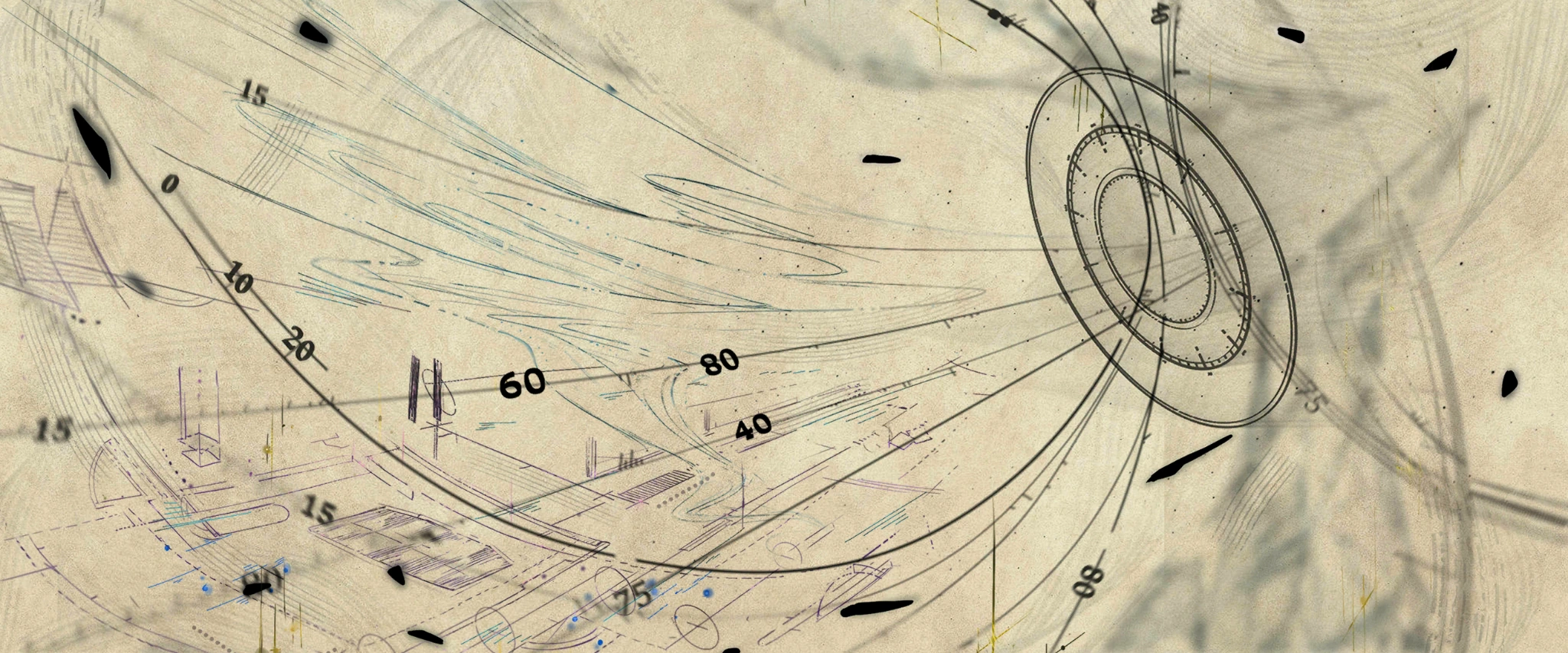
A landscape expressed as linesGame artwork. Its curves and numbered marks are visual context; they are not measurements used by the simulations below.
INTERACTIVE TRACING · NOT FIELD DATA
EXPERIMENT 1 · READ THE DRAWING
The leyline instrument
The game’s drawing, traced by hand into rings and curves you can select. Scroll to zoom, tap a ring or a path.
What it means. A drawn curve has a shape. What it stands for depends on a rule nobody has given us. Here it is geometry, not a proven energy channel.
How the image becomes a tracing
The reference image is placed on a flat plane. Three elliptical rings and eight cubic Bézier paths are manually approximated from its composition; they are not automatic pixel extractions. Every interpreted point lies in the same plane. Faceted fragments, graduations and optional moving pulses provide visual context. The analytical view reveals control points and guide connections. Lengths use arbitrary scene units, not meters or ley-energy measurements. Pulse speed has no physical interpretation. No network connectivity is inferred where curves appear to cross. + / − zoom; Home resets the view.
The image is Reverse: 1999 game artwork. Reconstruction: ACD / Palim. Rendering uses Three.js r160, bundled locally under its MIT license. The instrument pauses when its research tab is hidden or the document is inactive. Animation starts only when requested and respects reduced-motion preferences.
Drag to rotate. Height is an invented response, not elevation, time or Storm probability.
EXPERIMENT 2 · DESCRIBE A FIELD
An invented landscape
Suppose every spot on a map had a “ley response”. Higher ground means a stronger one. The lines join spots with equal values.
Try. Switch to Plan view, change the deformation, pick a station. The notebook reports what that station reads.
Station notebook
What it means. A line on this map joins equal values. It is not automatically a route that energy travels.
Field equation and observation rule
φ(x,y) = sin(0.8x + 0.35y) + 0.6cos(0.55y − 0.3x) + d·sin(1.3x − 0.9y), on [−4,4]². The deformation d is a controllable scenario, not elapsed time. The mesh has 41 × 41 vertices; contour crossings use linear interpolation within marching-square cells. Survey stations return φ and its analytic gradient. The small chart is a slice through the landscape at the selected station’s fixed x. Closely spaced contours mean a steeper response gradient; they do not imply a denser physical network or a danger zone. Units are arbitrary. Arrow keys rotate; plane views keep increasing axes rightward and upward.
Twelve made-up landmarks and the straightest line through them. Drag one and the line changes. Yellow sites support the line.
EXPERIMENT 3 · CHALLENGE A LINE
Is the alignment special?
Enough landmarks and a generous tolerance make a random map look ordained. So the same search is run on 399 random maps, to see how often chance does as well.
Try. Choose “Uniform random”, then press Run comparison. The chart shows where your map sits among the random ones.
Run the comparison to evaluate this map.
What it means. If random maps do as well, the alignment means little. Even a rare result only rejects one model of chance.
Test statistic, search correction and keyboard controls
The null is a geographical assumption. Compare a clustered map against clustered simulations before interpreting its apparent alignment.
For every distinct pair of sites, count points within perpendicular distance ε of its infinite line. T is the largest count over all 66 pairs. Every null map has 12 sites and repeats the entire 66-pair search, accounting for the selection of the strongest line. Report p = (1 + number of simulated T ≥ observed T) / 400. The null is either uniform on [−4,4]² or equal-probability sampling from two bounded square clusters of width 2.4 centered on (−1.8,−1.2) and (1.8,1.2). Each run uses seed 1999; estimates are reproducible, finite-resolution Monte Carlo comparisons. This is not a test on game locations. Hand-moving sites or repeatedly changing ε is exploratory and does not provide confirmatory significance.
Nine stations joined by an invented network. Size and colour show the response. A dashed grey link is the one you removed.
EXPERIMENT 4 · TEST A NETWORK
Cut a link, apply a reset
If a network existed, a disturbance would spread along its links. One unit is injected at a station. A reset arrives at t = 6.
Try. Set retention to 100% and remove a link. Then restore it and lower retention. Top chart: the starting station. Bottom: the total of all nine.
What it means. Cutting a link moves the response around. Only the reset removes it. Connection and survival are separate assumptions.
Transport equation and boundaries
Reference: all links present, no reset. Counterfactual: selected link removed, selected retention applied at t = 6. The comparison intentionally combines those two interventions; set retention to 100% to isolate a cut, or choose no removed link to isolate the reset.
du/dt = −κLu − 0.08u, where L = D − A is the unweighted, undirected graph Laplacian. Initial u is one unit at the station selected in the field survey. Euler integration uses dt = 0.02 over 12 dimensionless time units. The counterfactual applies u⁺ = ru⁻ at step 300 (t = 6); there is no calendar-year mapping. In this model diffusion redistributes response and damping removes it. Neither this transport equation nor reset retention is a claimed law of fictional leylines.
VISUAL ARCHIVE · GAME ART
Reading the drawing, questioning the model
A curve can be a path, a line of equal values, or a connection. The artwork suggests questions; each experiment above says which meaning it uses.
A Dark SurveyCurves and concentric rings against a dark field.The Near ViewNumbered marks and intersecting curves.The Wider ViewThe surrounding spatial drawing. No physical scale is inferred from any of these.
5 · BACK TO THE STORM
What could belong to a Storm?
The record holds departures, landings and story events. It holds no field surveys. So these are three questions to investigate, each with the result that would count against it.
H₁ / WHERE
A field shapes where the effects fall
Compare station readings before an event with what happened after, allowing for population, geology and access to shelter.
Would weaken it: no repeatable link between place and effect once those are allowed for.
H₂ / HOW FAST
The network carries a disturbance
A change should reach connected stations sooner than equally distant unconnected ones. Record onset times before choosing the paths.
Would weaken it: network distance predicts nothing that ordinary distance does not.
H₃ / WHAT SURVIVES
Some structure outlasts a reset
Repeat surveys at the same sites across a Storm, with calibrated instruments. Separate real persistence from an observer or device carrying the pattern forward.
Would weaken it: the recurring signal follows the instrument, not the site.
How this joins Chaos Theory. That tab studies how rules and triggers change an outcome. This one adds place: which station sees which response. An irregular record, an aligned map and a twitching detector are three different claims. None alone establishes a mechanism for the Storm.
Nhong was here
References
Game text is reproduced by community archives; the simulations are independently constructed for this dossier. Research reviewed 1 October 2026. Character and story spoilers follow.
Live Science · The Lore and Lure of Ley Lines — background on Watkins’s alignment idea, later energy claims and their lack of scientific support; distinct from the fictional game setting.
Windsong · Character Profile & Silver Isoheight — community-hosted game text. Source for her monologue, LSCC ID card, ranging goggles and ley-energy detector. Used for the fictional detector description and collaboration context; no character biography is required to read the experiments.
Polar Town · Ley Line Mapping Review Guide — in-game archive text, community transcription. Supports the discussion of mapping, geometry and spatial reasoning; does not supply numerical field equations.
SciPy · Monte Carlo Hypothesis Tests — primary technical documentation for comparing a statistic against simulations under a specified null. The browser test here implements its own seeded spatial experiment and conservative tail estimate.
Hu, Urschel & Zikatanov · Graph Laplacians — primary mathematical paper on graph Laplacian structure and applications. Our unweighted transport model adds explicit damping and a hypothetical reset.
ACD · Constructed experiment definitions — equations and assumptions are documented beneath each experiment. Coordinates, φ, network links, response units and resets are synthetic. The alignment distribution contains 399 generated maps; no real-world leyline dataset or game field measurements were used.
Leyline artwork: five Reverse: 1999 game images. Presented as visual context, not field measurements or evidence of Storm coupling.
Chaos theory studies systems whose rules are exact while their far future stays hard to predict. This page lets you break four toy systems on purpose, then asks what any of it can say about the Storm.
THE IDEA
Two almost identical beginnings, under the same rule, can end far apart. Nothing random is needed for that to happen.
HOW TO READ THIS PAGE
One experiment per screen. The thing you can move is on the left. On the right are three short lines: what to try, what to watch, what it means.
THE HONEST LIMIT
Every simulation here is a teaching toy with invented numbers. Eleven Storms cannot show that the Storm is chaotic. The last section says what could.
Where this comes from. In the game, research like this belongs to its characters and institutes. This page is my own attempt at it, worked out with Palim. The mathematics is standard and referenced; applying it to the Storm is this archive’s own speculation, not game canon.
BEFORE YOU START · THREE WORDS
Clear rules, uncertain outcomes
Release two leaves side by side into a fast stream. They travel together, then the water pulls them apart. That is the whole subject: a small difference at the start that grows.
State
Everything that describes a system at one moment, plotted as a single point. As the system changes, the point draws a path. In the 3D portraits below the axes are variables, not directions of time.
Attractor
The shape the paths keep returning to. The Lorenz butterfly is one. A stable shape does not make the next step easy to forecast, and it is not a map of eras.
Horizon
How far ahead a forecast stays useful before a small measuring error has grown too large. Better measurements push the horizon back. They do not remove it.
The longer explanation
In the demonstrations below, the rules are written down and no random input is needed. Even so, some settings produce trajectories that eventually diverge. Because a measurement can never specify every starting value perfectly, this growth limits how far ahead a precise forecast remains useful. “Deterministic” means the same complete state follows the same rule, not that we can measure that state well enough to predict forever. Not every deterministic setting is chaotic.
The Storm gives us a record of anomalous outcomes. Chaos theory gives us ways to ask about the hidden process behind them. An irregular sequence alone cannot tell us that the process is chaotic; the experiments build understanding before the last section asks what the record can actually support.
The mathematical version of a forecast horizon. During approximate exponential error growth, δ(t) ≈ δ₀eλt. For tolerance ε and positive growth rate λ, t ≈ ln(ε/δ₀)/λ. This is a local approximation before separation saturates, not a Storm forecast.
View
Drag to rotate. Orange: the reference path. Mint: the path that started a hair away. Coordinates have no units.
EXPERIMENT 1 · CHANGE THE BEGINNING
Two paths, one rule
Two points start almost on top of each other and obey exactly the same equations. Watch how long they agree.
Try. Make the initial difference smaller.
Watch. The chart below: the gap between the two paths. Each step up is ten times wider.
What it means. A smaller starting error delays the split. It does not prevent it. This is a mathematical toy, the Lorenz system, not a measured Storm.
Equations & numerical method
dx/dt = 10(y − x); dy/dt = x(ρ − z) − y; dz/dt = xy − (8/3)z. Initial states (1, 1, 1) and (1 + 10−k, 1, 1). Fourth-order Runge–Kutta, step 0.01, 6,000 steps. The portrait omits the first 500 steps; the separation plot retains them. The plot shows Euclidean separation on a logarithmic scale; it is not an estimated Lyapunov exponent. In the XY view +x points left and +y upward; the corner guide shows orientation. Finite numerical precision limits long-term trajectory agreement.
Top: where the system settles for each setting of r. Bottom: whether small differences shrink or grow there. The yellow cursor picks the setting shown underneath; drag it, or use the slider.The sequence at the selected r, once it has settled.
EXPERIMENT 2 · CHANGE THE RULE
One dial, many behaviours
A single rule with a single dial, r. Turn it and the same rule first settles, then cycles, then never repeats.
Try. Press the four buttons from left to right.
Watch. The lower chart goes from a flat line, to a repeating zigzag, to something with no pattern.
What it means. Changing the rule is a different experiment from changing the beginning. A system can be tame at one setting and wild at the next.
The rule, the diagnostic and the sampling
The rule is xn+1 = rxn(1 − xn). λ is the average of ln|r(1 − 2x)| along the orbit. A positive estimate indicates average local expansion for this simulated orbit; a negative estimate indicates contraction. Values near zero require care, longer runs and numerical checks. Periodic windows interrupt the chaotic region.
800 evenly spaced r values between 2.5 and 4; initial x = 0.213; 1,000 discarded iterations, then 500 for λ and the final 80 for the state diagram. The sequence chart shows 100 iterations after discarding 1,000. Logarithms use a 10⁻¹⁵ derivative floor to keep the drawing finite near superstable points. The finite grid cannot resolve every window.
Between experimentsA change in the rule, a change in the initial state, and a change in the measurement are different experiments.
Mint: what is building up. Yellow: the trigger line. Every drop is a reset. All units are invented.
EXPERIMENT 3 · ADD A TRIGGER
Build up, cross the line, reset
Something unseen accumulates. When it crosses the yellow line an event fires and the count drops to zero. That is the outline of a Storm-like event, with every number made up.
Try. Switch the driver, then raise the threshold.
Watch. The spacing between the drops.
What it means. Events can arrive at uneven intervals while the trigger rule never changes. Irregular timing does not need irregular rules.
What the analogy adds, and what it leaves open
Adds. Uneven event spacing can come from a hidden evolving state plus a trigger. A reset can erase part of that state while leaving other variables intact.
Leaves open. The quantity, threshold, reset rule and external forcing are unknown for the Storm. Calendar displacement and waiting time are separate outputs. This demonstration supplies neither an era destination nor a forecast.
An intervention question. Would an intervention change the trajectory, shift the trigger, or change the rule itself? These mechanisms can look similar in an event log but imply different experiments.
Toy assumptions. x follows the logistic map from x₀ = 0.213. At each step, q increases by 0.15 + 0.35x. When q ≥ θ, an event is recorded and q resets to zero. 180 steps; the vertical axis stays fixed from 0 to 5.5. The driver keeps evolving through resets. This is a constructed threshold system, not a fitted model or a proposed canon mechanism.
The discussion tableAn analogy becomes useful when its assumptions can be questioned.
Drag to turn. Tap a mark to inspect that reset. Orange: run A. Mint: run B. Yellow: the selected reset.
EXPERIMENT 4 · ALL FOUR LAYERS
Hybrid Observatory
A hidden flow, a trigger, a reset, and a calendar that only shows the result. Runs A and B differ in one layer; “Compare” picks which.
What it means.
EXPERIMENT 4, CONTINUED · THREE READOUTS OF THE SAME RUN
Calendar output
Two made-up calendars produced by those resets. The year is an output of the toy rule, not an input.
State separation
How far apart the two runs are at each moment. Sudden jumps come from resets.
Trigger section
Where the system was just before each reset. Select a point to inspect that event.
Read the experiment
Nearby initial state: keep the flow and event rules identical; change only the starting x. Shifted threshold: keep the initial state and reset retention identical; change what counts as a trigger. Changed retention: keep the initial state and trigger identical; change what survives an event. A calendar record can differ under all three experiments. The record alone does not identify which component changed.
The Chaos portraits mirror X: in XY, +x points left and +y points upward; the corner guide follows the camera. Numerical diagnostic plots retain their labeled increasing axes; XZ and YZ isolate other pairs. The trigger section samples pre-reset states on z = θ; crossings are resolved by integration steps, so it is an approximate section. State separation is log₁₀ Euclidean distance between A and B at the same simulation time; it is not a Lyapunov estimate. The displayed A and B event counts cover the revealed time window; event-order comparisons do not imply matched physical events.
Equations, assumptions and limits
Flow: dx/dt = 10(y − x), dy/dt = x(28 − z) − y, dz/dt = xy − (8/3)z. RK4, dt = 0.01, 8,000 steps; initial (1,1,1). Trigger: upward crossing of z = θ. Reset: (ax, ay, 0.55θ). Output: Δyear = round(2x⁻). Both artificial calendars start at 1999; ordinary calendar passage is omitted. Initial-state experiments add 10−k to x₀; trigger experiments shift θ; retention experiments shift a within [0.05, 0.99]. The year mapping and reset have no established counterparts in the Storm record. Crossing-time accuracy is limited to the step, and long-term paths are sensitive to numerical precision.
Exercise Each real jump (across) against the jump that followed it (up), in calendar years. Ten pairs from eleven Storms.
5 · BACK TO THE RECORD
What can eleven Storms tell us?
If the Storm followed a simple hidden rule, these points might fall along a curve. Ten points are far too few to show one.
The record supports: the direction changes, and the jumps are unequal.
It does not support: a chaos estimate of any kind. There are no measured internal variables, no known rule, and no pairs of nearly identical starts.
Equally possible: a hidden deterministic rule, random forcing, interventions, or a rule that changes.
What it means. The reversal of eras is what was recorded. Calling it “chaos” would need evidence about what produces it. A butterfly motif is not that evidence.
5, CONTINUED · WHAT WOULD SETTLE IT
Four questions, and the evidence each one needs
Research question
Useful evidence
Competing explanation to test
Sensitive dependence?
Repeated nearby measured states followed over time, under comparable forcing.
Measurement error or different external conditions.
Threshold-triggered Storm?
A reproducible precursor quantity approaching a boundary before events.
Scheduled triggers, manipulation, or selective observation.
Stable dynamics across eras?
Consistent state variables and rules before and after successive resets.
Structural changes, different observational definitions.
Control versus prediction?
Recorded intervention timing, mechanism, and matched untreated cases.
Coincidence, attribution bias, or a shifted event rather than prevention.
A more useful Storm model, and two cautions
Separate a latent state z, a Storm condition g(z) = 0, a reset R(z), and an observable calendar destination h(z). This hybrid-system vocabulary makes assumptions inspectable: what persists, what is overwritten, what triggers the anomaly, and what determines its direction? The archive supplies outputs; future evidence would need to constrain the hidden machinery.
Edward Lorenz’s equations and the game’s Institutum Lorentz should not be conflated; neither a butterfly motif nor the name of an institution identifies a mathematical mechanism. The return plot above is an event-to-event diagnostic, not a reconstructed attractor, and this page does not estimate a Storm Lyapunov exponent, fractal dimension, or chaos probability.
Chaos control is a further, distinct idea: Ott, Grebogi and Yorke studied small interventions that stabilize unstable periodic behavior in a chaotic system. That result is a mathematical research precedent, not evidence that any in-game intervention uses that mechanism.
Nhong was here
References
Where the mathematical explanations and demonstrations come from, in case you want to check the equations and their limits yourself. Sources for the Storm record are listed with that record.
Artwork: Reverse: 1999 / Bluepoch; background images from the game. Used here as visual context for an unofficial fan research project. The simulated plots are generated by this page.
UNIT Σ//ACD WATCH · STORM MONITORING TERMINAL
RESTRICTED · MODEL ROOMS
00%
Beyond this point
This is a personal space. The Model Rooms are not part of the public record and are not meant to be shown or shared in any way.
No duty to the community. The creator takes no responsibility for anything here that the community might expect. Nothing past this door is published, reviewed or promised to anyone.
Personal entertainment only. Anyone with the passcode agrees to treat what they see as entertainment. It makes no claim to clarity, and none of its information has been verified in any way.
By entering you accept the above. This screen appears every visit; the passcode is asked only once on this device.